

Biodiversity Conservation
Ecosystem based adaptation provides natural solutions that build our resilience to climate change.
For example, steep slopes in our region are often stabilised by deep rooted vegetation. As rainfall is expected to be more intense in the future, this natural buffer protects communities from flooding and landslides and also ensures that reefs are healthy by reducing the impact of sediment flows from erosion.
Having a healthy environment around us also secures our supply of freshwater, food and other natural resources. These are called 'ecosystem services' and are the added benefits that do not come when 'hard' engineered adaptation solutions, such as seawalls, are built.
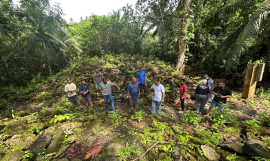
 Fisheries and adaptation education for communities on Abaiang atoll with staff from the Environment and Conservation Division, Ministry of Environment, Lands and Agricultural Development, Kiribati.
Fisheries and adaptation education for communities on Abaiang atoll with staff from the Environment and Conservation Division, Ministry of Environment, Lands and Agricultural Development, Kiribati."Natural solutions must be a key front line response to climate and many of the other challenges facing our region." said Mr. David Sheppard, the Director-General of the Secretariat of the Pacific Regional Environment Programme (SPREP).
There are many different approaches to adaptation. The best option will reduce the vulnerability of a group of people in the most cost effective way over the long term. This could be through conventional adaptation, ecosystem based adaptation or a combination of both.
For more information about Ecosystem based adaptation, please see the following publications at www.sprep.org:
Ecosystem-based adaptation : natural solutions for resilience to climate change
Pacific Islands Biodiversity, Ecosystems and Climate Change Adaptation: building on nature's resilience
A comparative analysis of ecosystem-based adaptation and engineering options for Lami town, Fiji : synthesis report
Ecosystem-based adaptation and climate change vulnerability for Choiseul Province, Solomon Islands : synthesis report
Legal frameworks for Ecosystem-Based Adaptation to Climate Change in the Pacific Islands
Ecosystem-based adaptation : natural solutions for resilience to climate change
Pacific Islands Biodiversity, Ecosystems and Climate Change Adaptation: building on nature's resilience
A comparative analysis of ecosystem-based adaptation and engineering options for Lami town, Fiji : synthesis report
Ecosystem-based adaptation and climate change vulnerability for Choiseul Province, Solomon Islands : synthesis report
Legal frameworks for Ecosystem-Based Adaptation to Climate Change in the Pacific Islands