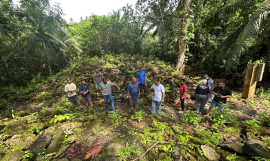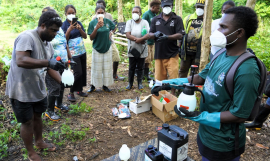

Barana, Solomon Islands – The recent Barana Community Reforestation Training successfully equipped community members, park rangers, and youth with essential knowledge and skills to execute sustainable reforestation initiatives.
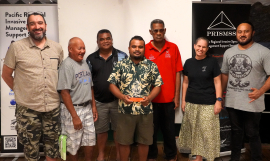
The training, hosted at the Barana Community Nature Heritage Park in Mount Austin, Guadalcanal Province, was organised by the Pacific Ecosystem-based Adaptation to Climate Change (PEBACC+) project implemented by the Secretariat of the Pacific Regional Environment Programme (SPREP) and funded by the Kiwa Initiative and the French Facility for Global Environment. The training was carried out in partnership with the Solomon Islands Ministry of Forestry and Research. A total of 40 participants, including men, women, and youth from the Barana community, as well as six technical officers from the Ministry, attended the training.
Ms. Melwyn Narasia, a leader in the Barana Community Nature and Heritage Park management committee, reflected on the value of the training, “Reforestation training was interesting as it aids us in understanding reforestation activities from obtaining wildings/seedlings to planting out seedlings, nurseries in the selected sites.”

As the chief guest, Mr. Wilfred Atomea, Deputy Secretary of the Ministry of Forestry and Research, commended the participants and emphasised the importance of implementing new skills to rehabilitate degraded land areas within the Barana Community Nature and Heritage Park.
Reforestation plays a crucial role in combating climate change by capturing carbon dioxide, preventing land degradation, and creating economic opportunities through sustainable timber harvesting, eco-tourism, and agroforestry. Proper training ensures that reforestation initiatives are executed effectively, maximising their environmental and economic impact.
Joanne Aihunu, PEBACC+ Country Coordinator with SPREP, emphasised the importance of reforestation in restoring ecosystems. “It’s about restoring ecosystems. Training helps ensure that trees are chosen and planted in a way that supports biodiversity, prevents soil erosion, and restores habitats for wildlife,” she stated. She further highlighted that empowering local people with reforestation knowledge fosters long-term stewardship.
The Barana Community Reforestation Training held from 7-13 November 2024, marks significant step in building local capacity for sustainable land restoration, ensuring that newly planted forests grow and thrive for future generations.
PEBACC+ is a €5.8 million regional project implemented by SPREP and funded by the Kiwa Initiative through its donors the European Union, Agence Française de Développement (AFD), Global Affairs Canada, Australian Government Department of Foreign Affairs and Trade (DFAT) and New Zealand Ministry of Foreign Affairs and Trade (MFAT), with co-financing from French Facility for Global Environment (FFEM).
This four-year project seeks to strengthen the resilience of ecosystems, economies, and communities to the impacts of climate change in Fiji, New Caledonia, Wallis and Futuna, Solomon Islands and Vanuatu. The project will develop, sustain, and institutionalise Ecosystem-based Adaptation to climate change in these five countries and territories.